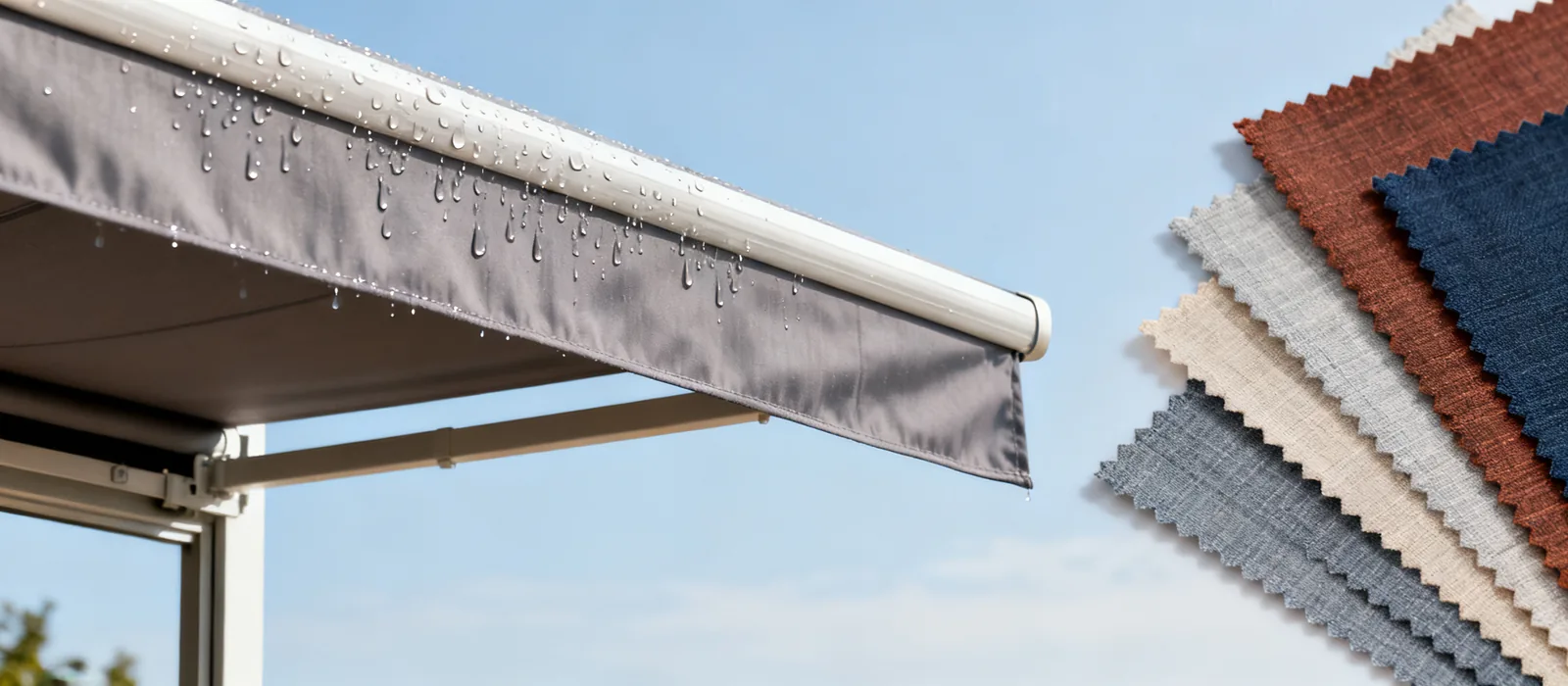
Awning specification and outdoor shade are the settings in scope. Exposure, contact, and panel processing each change which cloth detail matters.
Application exposure landscape
Contact
People touch valances, pulls, and the underside of a cover. Hand, surface fuzz, and colour seen from below are contact questions. They are not answered by a weather test. A physical cutting, viewed in the light the awning will actually sit in, is the reference for appearance. GSM can be identical across two cloths that feel different in the hand, so mass stays in its own field.
Care of an installed shade is part of contact too. Cleaning method, folding on a retractable system, and abrasion where hardware rubs the cloth should be described by the buyer. This page does not assign a cleaning cycle or an abrasion number. It asks for the maintenance the project expects, then keeps that note beside any later method that claims to represent wear.
Exposure
Outdoor shade cloth meets sun, rain, and wind-driven movement. Those stresses are not one property. Lightfastness, if it is discussed, needs a method and a specimen state. Liquid water resistance needs its own method, pressure or exposure condition, and the construction that was tested. Vapour movement, if the brief even requires it for a mostly open awning, is a separate method again. An outdoor photograph does not choose among them.
Location changes the brief. A covered terrace, a coastal frontage, and a high-sun courtyard do not present the same combination of UV, rain, and soiling. Write the setting in plain language. Then ask which recorded result, if any, was produced on a comparable specimen. Do not promote a single outdoor fabric label into permanent waterproofness or a universal weather claim.
Processing
Awning panels are cut, joined, and often hemmed around hardware. Usable width, not the full cloth width, governs how many panels a cover needs. Selvedge, coating that reaches the edge, and seam slippage belong in the processing note when they affect joining. A shade textile that looks continuous on screen may still be planned as several widths with seams.
Supply format sits next to processing. Ask whether the relevant format is a roll, a cut length, or another package, and record identification on that unit. Do not assume a roll length, a minimum, or a ship date because the end use is an awning. Quantity and destination explain the order. They do not prove that the same construction is available in the width the pattern needs.
Material and method trade-offs
These rows are selection factors for awning cloth. They are not a Sattler test report, and they do not name a winning supplier. Line up weave construction, shade reference, usable width, and the method behind any exposure claim before treating two commercial names as substitutes.
Four trade-offs that stay open until the brief names a construction
Question
One side
Other side
Natural and synthetic fibres
Natural fibres: discuss hand, moisture uptake, and the care the awning can support.
Synthetic fibres: discuss tensile strength, drying, and a functional finish. Environmental conclusions need a bounded assessment, not a fibre label.
Coating and lamination
Coated substrate: check coating add-on, adhesion, and flexibility on the stated base cloth.
Laminated construction: check the film, peel, and the specimen state. An outdoor photograph does not choose between them.
Stock and custom development
Stock: confirm the dated batch and whether replenishment is actually known. Unknown inventory stays unknown.
Custom development: control the change at sample, trial, and bulk approval. A development cutting is not a production standard.
Abrasion and hand
Durability: read abrasion resistance with the method, the end point, and any cycle count the offered report actually contains.
Hand: confirm pilling, surface, and drape on a physical cutting. GSM in g/m² does not settle either side.
Record mass in g/m², usable width in cm apart from selvedge, fibre composition as percent by mass summing to 100, and yarn linear density in dtex or denier. 1 denier is about 1.11 dtex. Roll length in m, when it applies, comes from the order, not from the end use. If a method cites ISO 139:2005, the temperate atmosphere is commonly 20 °C and 65% relative humidity, with tolerances often written as ±2 °C and ±4% relative humidity. That citation is not a statement that a Sattler lot was conditioned or measured.
No hydrostatic head in mm or kPa is published here.
No water vapour transmission in g/m² over 24 h is published here.
No colourfastness grade on the blue wool scale of 1 to 8 is assigned to this cloth.
No tear strength, seam slippage, or air permeability number is inferred from shade use.
Across these three settings the textile remains an outdoor performance fabric for shade. Finished awnings, furniture, and apparel are not the product being specified here. When two commercial names are compared, line up construction, shade reference, usable width, and the method behind any exposure claim before treating the names as substitutes.
Match the use before the material label
An application page is a way to frame the environment, the stress and the assembly question. It is not a list of completed installations. Describe contact, exposure, care and processing separately, then ask which evidence belongs to that condition.
Use conditions to separate in the brief
Condition
Question
Evidence context
Daily contact
What touch, care and surface change matter?
Physical sample and the stated care context
Moisture
Is the question liquid resistance or vapour movement?
Method and specimen conditioning
Assembly
How will the textile be cut or joined?
Construction and usable width
Colour
Which physical reference is under review?
Shade approval notes, not a screen swatch
Describe the use environment
Sun, rain, contact, and panel joining make an awning brief specific.